
Post
Facial Cleansing Brush Review: Gentle Enough for Sensitive Skin
May
However, for people with sensitive skin, the main concern is not whether the brush cleans well—but whether it is too harsh for daily use. Can a facial cleansing brush truly be gentle enough for sensitive skin, or does it risk causing irritation, redness, and damage to the skin barrier?
The answer depends heavily on the type of brush, how it is used, and the individual skin condition.
This review takes a detailed look at how facial cleansing brushes perform on sensitive skin, their benefits, risks, and whether they are worth adding to a skincare routine.
What Is a Facial Cleansing Brush?
A facial cleansing brush is a skincare device designed to enhance facial cleansing through mechanical or sonic movement. It typically uses:
- Soft bristles (manual or rotating brushes), or
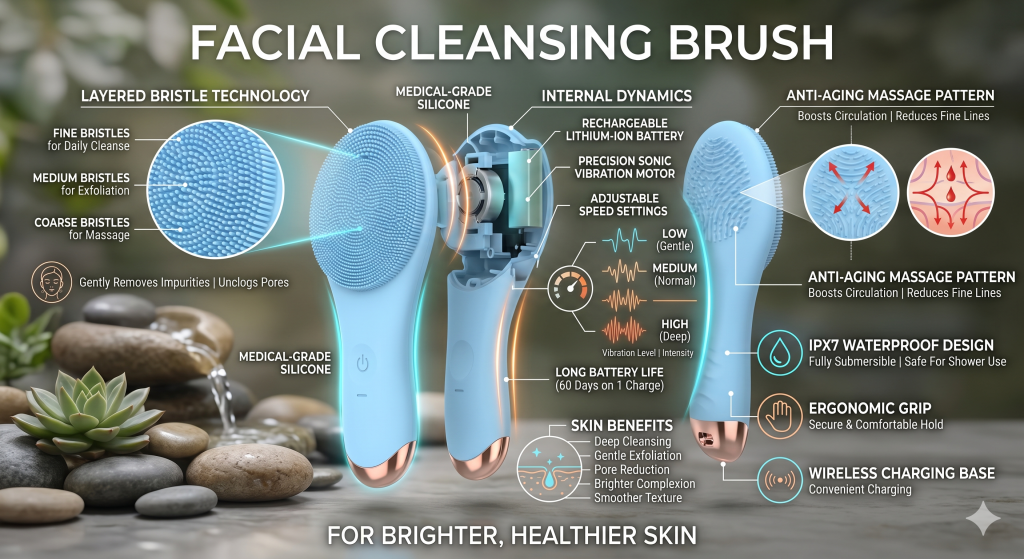
- Silicone nubs with vibration technology
The goal is to help remove dirt, oil, sunscreen, and makeup more effectively than manual cleansing.
Modern versions are usually electric and offer multiple vibration settings, allowing users to control intensity depending on skin type.
There are two main types:
1. Bristle Brushes
These use small nylon or synthetic bristles that rotate or vibrate against the skin.
2. Silicone Sonic Brushes
These use soft silicone points combined with sonic vibrations for a gentler cleaning effect.
Dermatology experts often note that silicone-based devices tend to be better tolerated by sensitive skin because they are less abrasive and easier to clean.
Why Sensitive Skin Needs Extra Care
Sensitive skin is more reactive to environmental factors, skincare ingredients, and physical friction. Common symptoms include:
- Redness
- Tightness after washing
- Burning or stinging sensations
- Dry patches
- Increased irritation from exfoliation
The skin barrier in sensitive skin is often more fragile, meaning it can be easily disrupted by over-cleansing or harsh physical scrubbing.
Because of this, any tool that involves friction—like a cleansing brush—must be used carefully.
Experts emphasize that while cleansing brushes can improve skin cleanliness, they are not essential and should be chosen carefully based on skin tolerance.
Do Facial Cleansing Brushes Actually Clean Better?
One of the main selling points of cleansing brushes is deeper cleansing.
Compared to hands alone, brushes can:
- Remove more surface dirt and oil
- Help clear makeup residue more effectively
- Provide light exfoliation
Some studies and product testing show that sonic brushes can remove a very high percentage of impurities from the skin surface.
However, dermatologists also point out that a good cleanser used with hands is often enough for most people. The brush mainly adds exfoliation rather than essential cleaning power.
So while they do improve cleansing efficiency, they are not strictly necessary for healthy skin.
Are They Safe for Sensitive Skin?
This is the most important question.
The answer is: they can be safe, but only under the right conditions.
Many dermatologists agree that silicone sonic brushes are generally safer for sensitive skin because:
- They are softer than bristles
- They do not scratch the skin surface
- They are easier to keep hygienic
- They offer adjustable vibration settings
Silicone brushes are often described as extremely gentle and suitable even for reactive skin types when used correctly.
However, safety depends heavily on usage habits. Problems usually arise when:
- The brush is used too often (daily overuse)
- Too much pressure is applied
- The wrong cleanser is used (harsh or exfoliating formulas)
- The skin barrier is already damaged
Over-exfoliation is one of the biggest risks, and it can lead to irritation and long-term sensitivity issues.
Real User Experiences with Sensitive Skin
Real-world feedback from users with sensitive skin is mixed.
Positive experiences:
- Skin feels cleaner and smoother
- Reduced buildup in pores
- Improved makeup removal
- Some reduction in blackheads with careful use
Negative experiences:
- Redness after use
- Tight or dry feeling
- Burning sensation on reactive skin
- Breakouts from overuse or irritation
Many users report that results depend entirely on frequency. Using a brush too often tends to trigger irritation, while limited use (1–3 times per week) is usually better tolerated.
Some users also find that switching to silicone brushes significantly reduces irritation compared to traditional bristle brushes.
Common Mistakes That Cause Irritation
Most problems with cleansing brushes do not come from the device itself, but from improper use.
1. Using It Too Often
Daily use is often too much for sensitive skin. Skin needs time to recover between exfoliation sessions.
2. Applying Too Much Pressure
Pressing harder does not mean better cleansing—it increases friction and damage.
3. Using Harsh Cleansers
Combining brushes with strong exfoliating cleansers or acids can overload the skin barrier.
4. Poor Hygiene
If the brush is not cleaned regularly, bacteria buildup can worsen breakouts and irritation.
5. Ignoring Skin Signals
Redness, stinging, or dryness are signs the skin is being over-stressed.
Benefits of Using a Facial Cleansing Brush (When Used Correctly)
When used properly, facial cleansing brushes can offer several benefits:
1. Improved Skin Smoothness
Light exfoliation helps remove dead skin cells, leading to a smoother surface.
2. Better Makeup Removal
Brushes can help break down foundation, sunscreen, and oil more effectively.
3. Enhanced Skincare Absorption
After gentle exfoliation, serums and moisturizers may absorb more efficiently.
4. Spa-Like Experience
The vibration and massage effect can feel relaxing and improve circulation.
5. Deep Cleansing for Oily Areas
The T-zone often benefits from deeper cleansing compared to cheeks.
However, these benefits are only noticeable when the brush is used gently and in moderation.
Limitations You Should Know
Despite their advantages, facial cleansing brushes are not perfect.
They are NOT necessary
Many dermatologists emphasize that hands are sufficient for cleansing in most cases.
Risk of over-exfoliation
Too much use can damage the skin barrier, especially in sensitive skin types.
Not suitable for all conditions
People with eczema, rosacea, or highly reactive skin may not tolerate them well.
Quality matters
Cheap brushes often have harsh bristles or weak vibration control, increasing irritation risk.
Best Type for Sensitive Skin
If choosing a facial cleansing brush for sensitive skin, these features are recommended:
- Soft silicone head
- Low vibration settings
- Adjustable intensity levels
- Waterproof design
- Gentle cleansing mode
Silicone sonic brushes are generally considered the safest option for reactive skin because they minimize friction and are easier to clean.
Final Verdict: Are They Worth It?
Facial cleansing brushes can be gentle enough for sensitive skin—but only when chosen and used correctly.
They are worth considering if:
- You choose a silicone sonic brush
- You use it only 1–3 times per week
- You avoid strong exfoliating cleansers
- Your skin barrier is healthy
They may not be suitable if:
- Your skin is highly reactive or easily irritated
- You prefer a very minimal skincare routine
- You already experience redness or barrier damage
Overall conclusion
A facial cleansing brush is not an essential skincare tool, but it can be a helpful upgrade for some users. For sensitive skin, the key is moderation, gentle technique, and selecting the right type of device.
Used properly, it can improve cleansing and skin smoothness without causing harm. Used incorrectly, it can easily become a source of irritation.
In short, it is not about whether facial cleansing brushes are good or bad—it is about whether they are used gently, correctly, and in the right routine for your skin type.
