
Post
Desk Drawer Organizer Review: Finally, a Tidy Workspace
May
A desk drawer organizer might seem like a very simple office accessory, but in practice, it solves one of the most overlooked productivity problems: daily clutter inside your workspace storage. While most people focus on desks, monitors, or chairs when improving productivity, the real mess often hides inside drawers—where pens, cables, notes, USB drives, and random items slowly turn into chaos over time.
A good desk drawer organizer changes that completely. It doesn’t just “store items”—it creates a system where everything has a fixed place, reducing time wasted searching and improving workflow efficiency.
But is it actually worth it, or just a cosmetic upgrade?
Let’s go deeper and analyze it properly.
What Is a Desk Drawer Organizer?
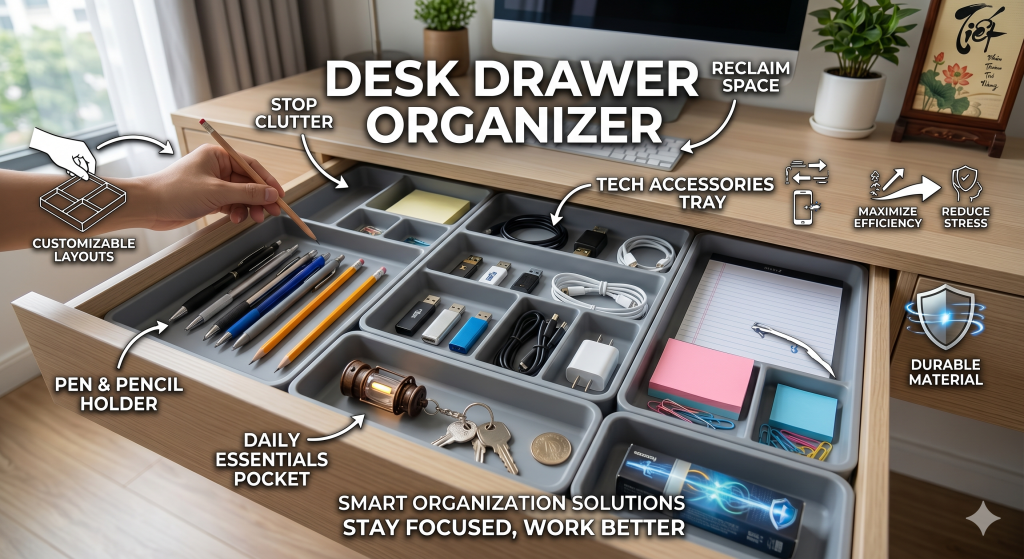
A desk drawer organizer is a structured storage system designed to divide a drawer into multiple compartments. Instead of one open space where everything mixes together, you get clearly separated sections for different types of items.
Common materials include:
- Plastic (lightweight, affordable, modular)
- Bamboo/wood (aesthetic, premium feel)
- Metal mesh (durable, industrial style)
- Silicone inserts (flexible, non-slip use cases)
Productivity gain∝1search time inside drawer\text{Productivity gain} \propto \frac{1}{\text{search time inside drawer}}
In simple terms:
- Less searching = more productivity
- More structure = less mental clutter
- Better organization = faster workflow
Why Drawer Organization Actually Matters More Than You Think
Most people underestimate how much time is lost due to small inefficiencies.
A messy drawer creates:
- Repeated searching for basic items
- Duplicate purchases (buying what you already own but can’t find)
- Interruptions in workflow
- Mental frustration during work or study
Research in workplace psychology shows that cluttered environments can increase cognitive load and reduce focus.
Even if each search takes only 10–20 seconds, over a week or month this adds up significantly.
For example:
- 10 searches per day × 15 seconds = 150 seconds/day
- That’s ~17 minutes per week
- Over a year: more than 14 hours lost just searching drawers
This is why organization tools like drawer dividers are considered a “small change with big impact.”
Types of Desk Drawer Organizers (Detailed Breakdown)
Not all organizers are the same. Choosing the right type depends on usage style, desk size, and item variety.
1. Modular Plastic Tray Organizers
These are the most common and widely used type.
Features:
- Multiple small trays of different sizes
- Can be rearranged freely
- Lightweight and affordable
- Easy to expand or reduce setup
Best for:
- Office stationery
- School supplies
- Mixed small items (clips, USBs, pens)
Real-world performance:
They work extremely well for general users because flexibility is high. You can rearrange layout anytime without buying new units.
2. Adjustable Divider Systems
These use sliding dividers inside a single tray.
Features:
- Custom compartment sizes
- Clean, structured layout
- Better for larger drawers
- Less modular but more stable
Best for:
- Tech accessories (chargers, cables)
- Office tools
- Users who want consistent layout
These are often preferred in professional setups where items do not change frequently.
3. Bamboo / Wooden Organizers
These focus more on aesthetics and durability.
Features:
- Natural premium look
- Strong build quality
- Fixed compartments (less flexible)
Best for:
- Minimalist desk setups
- Executive offices
- Visible drawers (glass or open designs)
They are often used in aesthetic workspace setups because they look clean and professional.
4. Metal Mesh Organizers
Less common but very durable.
Features:
- High strength
- Industrial design
- Long lifespan
- Resistant to deformation
Best for:
- Heavy-use environments
- Tools and larger items
- Industrial or tech workspaces
Real-World Performance: What Actually Changes After Using It
The biggest difference appears immediately after organizing.
1. Faster access to items
Instead of digging through a pile, everything becomes visually structured.
2. Reduced mental friction
A clean drawer reduces small distractions that interrupt focus.
3. Better workflow consistency
You always know where things are located.
4. Easier maintenance
Once organized, it takes seconds to maintain order.
5. Improved desk aesthetics
Even though it’s inside a drawer, opening it feels satisfying and controlled.
Productivity Impact: Small Tool, Big Effect
A well-organized drawer improves workflow indirectly but consistently.
Think of it like this:
Efficiency=completed taskstime wasted searching\text{Efficiency} = \frac{\text{completed tasks}}{\text{time wasted searching}}
When search time drops:
- Work starts faster
- Interruptions decrease
- Focus improves
Even small improvements compound over time, especially for students, developers, designers, and office workers.
Real User Experience: What People Notice
After using desk drawer organizers, most users report similar changes.
Positive outcomes:
- Desk feels instantly cleaner
- Easier to keep things organized long-term
- Less frustration during work sessions
- Improved productivity flow
- Better sense of control over workspace
Common complaints:
- Cheap plastic versions can slide inside drawers
- Over-compartmentalization wastes space
- Misjudging drawer size leads to poor fit
- Some layouts feel restrictive if not planned well
Advantages of Desk Drawer Organizers
1. Immediate organization
No learning curve—instant improvement.
2. Space optimization
Even small drawers become highly functional.
3. Low cost, high impact
One of the cheapest productivity upgrades.
4. Reduces clutter accumulation
People naturally avoid mess when structure exists.
5. Scalable system
You can expand across multiple drawers easily.
Limitations You Should Consider
1. Drawer compatibility issues
Not all drawers fit standard organizer sizes.
2. Over-organization risk
Too many compartments can reduce usable space.
3. Cheap material instability
Low-quality trays may shift or deform over time.
4. Limited for large items
Best for small accessories only.
Who Should Use a Desk Drawer Organizer?
Ideal for:
- Students with stationery clutter
- Office workers
- Remote workers
- Developers/designers with accessories
- Anyone with messy desk drawers
Less necessary for:
- Minimalists with few items
- Users who already use external storage systems
- People without dedicated desk drawers
Is It Worth Buying?
Yes—a desk drawer organizer is one of the highest ROI (return on impact) desk accessories available.
It provides:
- Faster access to tools
- Cleaner workspace
- Better mental clarity
- Improved workflow efficiency
- Long-term organization stability
It doesn’t just “look nice”—it changes how efficiently you interact with your workspace every day.
Final Verdict
A desk drawer organizer is a small, simple tool that delivers surprisingly large productivity benefits when used properly.
In summary:
- It eliminates drawer clutter permanently
- It reduces wasted time searching for items
- It improves workflow efficiency
- It is affordable and easy to implement
- It works in almost any workspace
Final conclusion:
A desk drawer organizer is absolutely worth it for anyone who wants a cleaner, faster, and more efficient workspace, turning hidden clutter into a structured system that quietly improves productivity every single day.
