Post
Professional Hair Dryer Review: Fast Drying Without Frizz
May
A professional hair dryer has become more than just a styling tool—it is now an essential part of daily grooming for people who care about hair health, smoothness, and time efficiency. While basic hair dryers simply focus on blowing hot air, professional models are designed to balance airflow, heat control, and advanced technologies like ionic and ceramic systems to reduce frizz while speeding up drying time.
The biggest promise from most brands is simple: faster drying without damaging or frizzing the hair. But does it really work in real life, or is it just marketing language?
Let’s go deeper into how these devices actually perform.
What Defines a Professional Hair Dryer?
A professional hair dryer is not just about appearance or branding—it is defined by performance and internal technology.
Most professional-grade models include:
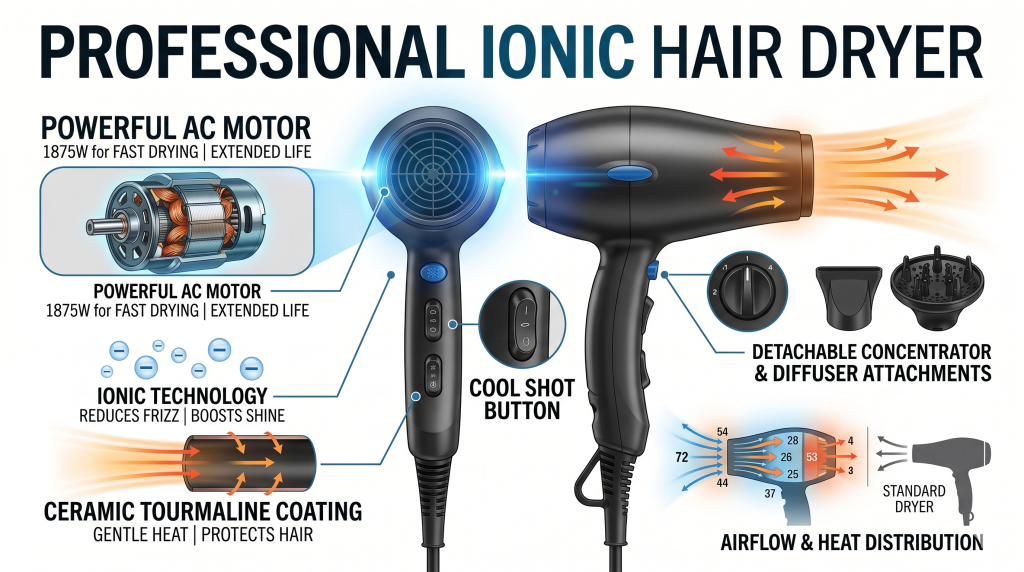
- High-power motor (1600W to 2200W or more)
- Ionic technology for frizz reduction
- Ceramic or tourmaline heating system
- Multiple heat and speed settings
- Cool shot button for styling lock-in
- Concentrator nozzle and diffuser attachments
The goal is not just to dry hair quickly, but to do it in a way that maintains moisture balance and reduces heat damage.
Unlike cheap dryers that rely on extreme heat, professional models focus more on controlled airflow combined with efficient heat distribution.
Fast Drying: Why Airflow Matters More Than Heat
Many people assume that higher heat means faster drying, but that is not entirely correct. Professional hair dryers prioritize airflow speed over raw temperature.
High-performance motors generate stronger airflow, which:
- Pushes water out of hair faster
- Reduces drying time significantly
- Requires less heat exposure
This is important because excessive heat is one of the main causes of dry, brittle, and damaged hair.
Drying efficiency∝airflow speed×heat control balance\text{Drying efficiency} \propto \text{airflow speed} \times \text{heat control balance}
In real-world use, this means:
- Medium-length hair can dry in a few minutes
- Thick hair dries faster with sectioning
- Less time under heat reduces long-term damage
Professional dryers do not just “blast heat”—they optimize how air moves through the hair.
Frizz Control: The Role of Ionic Technology
Frizz is one of the most common hair concerns, especially in humid environments or for naturally dry and wavy hair types. This is where ionic technology plays a major role.
How ionic technology works:
- Hair becomes positively charged when wet
- Ionic dryers release negative ions
- These neutralize static electricity
- Hair cuticles lie flatter
The result is smoother, shinier hair with reduced flyaways.
Many studies and product tests show that ionic dryers can significantly reduce frizz and improve smoothness compared to standard models, especially when used correctly.
What you actually see in real life:
- Less “poofy” hair after drying
- More defined strands
- Noticeably smoother texture
- Reduced static in dry air conditions
However, ionic technology does not permanently fix frizz caused by damage or poor hair health—it only improves the surface condition during and after drying.
Ceramic, Tourmaline, and Titanium: What’s the Difference?
Professional dryers often combine different heating materials, each affecting performance differently.
Ceramic technology
- Even heat distribution
- Reduces hot spots
- Gentle on fine or damaged hair
- Good for everyday use
Tourmaline technology
- Naturally emits negative ions
- Enhances frizz reduction
- Adds shine to hair
- Often combined with ceramic
Titanium technology
- Heats quickly and maintains high temperature
- Strong airflow performance
- Ideal for thick, coarse, or curly hair
- More powerful but requires careful use
Many modern dryers combine these technologies to balance speed, heat protection, and styling performance.
Real-World Experience: What You Actually Notice
When using a professional hair dryer daily, the difference becomes clear in a few key areas.
1. Faster drying time
Hair dries significantly quicker compared to basic dryers, especially for medium to long hair.
2. Smoother finish
Hair appears more polished, with fewer flyaways and less puffiness.
3. Improved shine
Because cuticles lie flatter, light reflects more evenly, making hair look healthier.
4. Better styling control
The combination of airflow and heat settings allows more precise styling, especially for blowouts.
5. Less heat damage over time
Because drying time is reduced, hair is exposed to heat for a shorter duration.
These effects are especially noticeable for users with frizzy, thick, or wavy hair types.
What Causes Frizz (Even With a Good Dryer)
A professional hair dryer improves frizz, but it cannot fully eliminate it because frizz is influenced by multiple factors:
- Hair damage or split ends
- Humidity and weather conditions
- Lack of moisture in hair
- Rough towel drying
- Overuse of heat tools
- Chemical treatments (bleaching, coloring)
Even the best dryer cannot completely override poor hair health or extreme environmental conditions.
Technique Matters as Much as the Tool
One of the biggest misconceptions is that a good hair dryer alone guarantees perfect results. In reality, technique plays a huge role.
Proper drying technique includes:
- Using medium heat instead of maximum heat
- Keeping the dryer moving constantly
- Drying hair in sections
- Using a concentrator nozzle for smooth airflow
- Finishing with cool air to lock style
Professional stylists rely heavily on technique, not just equipment.
A high-end dryer used incorrectly can still produce frizzy results, while a basic dryer used properly can still look decent.
Limitations of Professional Hair Dryers
Even though they are advanced, professional dryers are not perfect.
1. Higher price point
They are significantly more expensive than basic models.
2. Learning curve
Users need time to learn proper styling techniques.
3. Weight and noise
High-performance motors can make devices slightly louder or heavier.
4. Marketing exaggeration
Not all “ionic” or “salon-grade” claims provide noticeable real-world differences.
5. No permanent frizz solution
They improve appearance but do not permanently fix hair damage.
Who Should Use a Professional Hair Dryer?
A professional hair dryer is best suited for:
- People with frizzy or dry hair
- Users with thick or long hair
- Individuals who style hair regularly
- People wanting salon-like results at home
- Users living in humid climates
It may not be necessary for:
- Short hair that dries quickly
- Minimal styling routines
- Users on a tight budget
- People who rarely use heat tools
Is It Worth the Investment?
Yes—a professional hair dryer is worth it for most people who care about hair appearance and health.
It provides:
- Faster drying time
- Reduced frizz and static
- Better shine and smoothness
- Lower long-term heat damage
- More consistent styling results
However, its effectiveness depends heavily on:
- Hair type
- Usage technique
- Overall hair care routine
It is not a magic solution, but it is a significant upgrade over basic dryers.
Final Verdict
A professional hair dryer is one of the most practical upgrades in personal grooming. It does not just dry hair—it improves the entire styling process by combining controlled heat, powerful airflow, and ionic technology.
In summary:
- It significantly reduces drying time
- It improves smoothness and shine
- It helps control frizz, especially in humid conditions
- It works best when combined with proper technique
While it cannot eliminate frizz permanently or repair damaged hair, it can dramatically improve the way hair looks and feels after every use.
For anyone struggling with slow drying, lack of smoothness, or persistent frizz, a professional hair dryer is a high-impact, everyday beauty tool that delivers noticeable results when used correctly.
