
Post
Kids Building Blocks Set: 300 Pieces of STEM Fun
May
Building block toys have been a core part of childhood for generations, and despite the rise of digital entertainment, they remain one of the most valuable educational toys available today. A 300-piece kids building blocks set is especially popular because it offers enough variety for creativity while still being manageable for children to use and organize.
Unlike passive toys that only entertain for a short time, building blocks encourage children to think, experiment, and solve problems. They combine play with learning in a way that supports long-term cognitive development.
But with so many toy options on the market, parents often ask a practical question: Is a 300-piece building block set really worth it, and does it truly provide meaningful STEM learning benefits?
To answer that, we need to look deeper at how these toys work in real life, what skills they develop, and whether they are suitable for different age groups.
What a 300-Piece Building Block Set Actually Includes
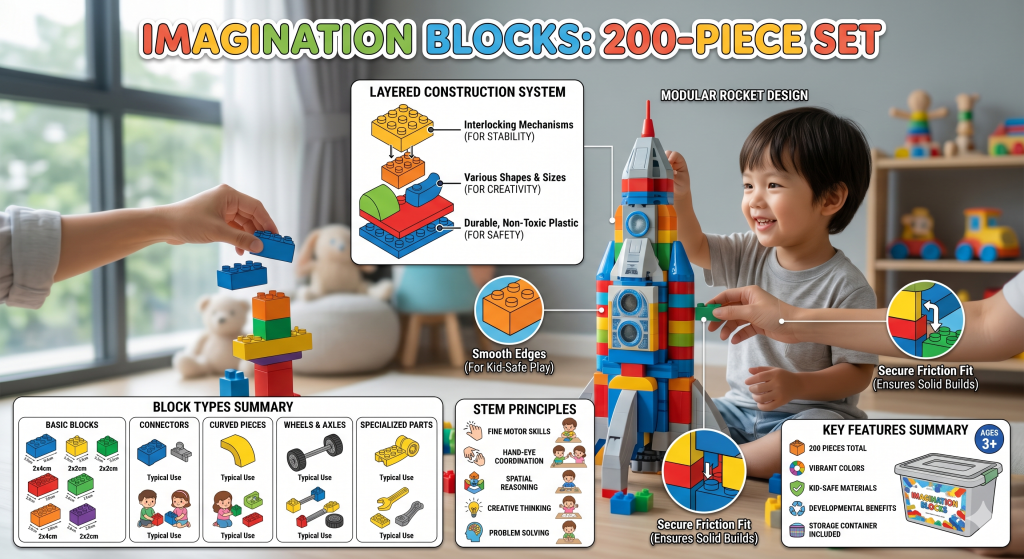
A 300-piece building block set is typically designed as a large starter or intermediate construction kit for children. While exact contents vary depending on the brand, most sets include:
- Standard interlocking plastic blocks
- Flat base plates
- Wheels and axle pieces (for vehicles)
- Curved and angled pieces
- Bright multi-color selection
- Storage container or box
Some STEM-focused versions also include themed elements such as:
- Mini figures
- Roof pieces for houses
- Decorative shapes
- Instruction guides for model building
For example, some educational kits are designed with multiple colors and shapes specifically to encourage visual recognition and early engineering thinking.
The key idea behind 300 pieces is flexibility: children have enough components to build complex structures without feeling limited.
Why Building Blocks Are Considered STEM Toys
STEM stands for Science, Technology, Engineering, and Mathematics. Building blocks naturally align with all four areas through hands-on learning.
Instead of memorizing concepts, children learn by doing:
- They test balance and structure (engineering)
- They explore shapes and geometry (math)
- They experiment with cause and effect (science)
- They develop logical sequencing (technology thinking patterns)
Educational experts often emphasize that construction toys help children understand spatial relationships and early engineering principles in a natural, playful way.
This is one of the reasons building blocks are commonly used in preschool and early education environments.
Key Developmental Benefits for Children
A 300-piece set is not just about entertainment—it plays a meaningful role in child development across multiple areas.
1. Creativity and Imagination Development
One of the most important benefits is creative freedom.
With hundreds of pieces, children are not restricted to predefined models. They can:
- Build imaginary cities
- Create fantasy creatures
- Design vehicles or robots
- Construct houses and towers
- Combine random shapes into unique structures
This type of open-ended play encourages divergent thinking, which is the ability to generate multiple solutions to a problem.
Over time, children become more confident in expressing ideas visually and physically.
2. Problem-Solving and Logical Thinking
Every building activity presents small challenges:
- Why is the structure collapsing?
- How can I make it more stable?
- Which piece fits correctly?
- How do I balance both sides evenly?
These challenges teach children how to analyze problems and adjust their approach.
This trial-and-error process is essential for developing critical thinking skills that will later be useful in math, science, and everyday decision-making.
3. Fine Motor Skills and Coordination
Manipulating small blocks strengthens hand muscles and improves coordination between:
- Eyes
- Fingers
- Brain
This is especially important for younger children who are still developing writing and drawing skills.
Activities like connecting, stacking, rotating, and separating pieces improve dexterity and precision.
4. Focus and Patience Building
Unlike fast-paced digital games, building blocks require time and concentration.
Children learn to:
- Stay focused on a task
- Work step-by-step
- Correct mistakes calmly
- Finish projects they start
This helps improve attention span and patience, which are essential skills for academic success.
5. Early STEM Foundation
Even though children are playing, they are unknowingly learning basic STEM concepts such as:
- Structural stability
- Balance and gravity
- Symmetry and geometry
- Spatial awareness
- Basic engineering design
These early exposures create a strong foundation for future learning in school subjects like math and science.
How Children Actually Use a 300-Piece Set
In real-world play, children rarely follow strict instructions for long periods. Instead, they explore freely.
Common behaviors include:
- Building random imaginative structures
- Rebuilding the same object in different ways
- Group play with siblings or friends
- Mixing storytelling with construction (e.g., “this is a city”)
- Sorting pieces by color or shape
This combination of structured and unstructured play is what makes building blocks so effective for development.
Advantages of a 300-Piece Set Compared to Smaller Sets
1. More Creative Freedom
Smaller sets limit what children can build. A 300-piece set allows larger, more detailed structures.
2. Better for Group Play
Multiple children can play at the same time without running out of pieces.
3. Longer Engagement Time
Children stay interested longer because they can continuously create new designs.
4. Scalable Difficulty
Younger kids can build simple structures, while older kids can attempt more complex designs.
Limitations Parents Should Consider
Despite its benefits, a 300-piece set is not perfect.
1. Mess and Organization
Large sets can easily become messy if not stored properly.
2. Risk of Lost Pieces
Smaller parts can be lost quickly, especially in households without storage systems.
3. Age Suitability
Not suitable for children under 3 due to choking hazards.
4. Quality Variation
Not all brands are equal. Low-quality sets may have:
- Loose fitting blocks
- Weak plastic material
- Poor color durability
- Difficult connections
Choosing a reputable brand is important for safety and long-term use.
Safety and Material Considerations
Parents should always check:
- Non-toxic materials
- BPA-free plastic
- Smooth edges
- Durable construction
- Certified safety standards
Safety is especially important for younger children who may put toys in their mouths.
High-quality sets are designed to withstand rough play while maintaining safety standards.
Educational Value in Schools and Learning Centers
Many teachers use building block sets in classrooms because they support:
- Group collaboration
- Early engineering thinking
- Communication skills
- Creativity exercises
They are often included in STEM-focused learning programs for preschool and primary education.
Children working together also learn social skills such as sharing, cooperation, and teamwork.
Is a 300-Piece Building Block Set Worth It?
From both educational and entertainment perspectives, the answer is yes.
A 300-piece set offers:
- Long-term play value
- Strong developmental benefits
- Affordable learning tool compared to tech toys
- High creativity potential
- Screen-free engagement
Compared to many modern toys that quickly lose interest, building blocks remain relevant as children grow.
However, value depends on usage. The toy is most effective when parents encourage creative play rather than only following instructions.
Final Verdict
A 300-piece kids building blocks set is one of the most well-rounded educational toys available today.
It successfully combines:
- Creativity
- STEM learning
- Motor skill development
- Cognitive growth
- Social interaction
While it requires organization and may not suit very young children, its benefits far outweigh its limitations.
In conclusion, this type of building block set is not just a toy—it is a hands-on learning tool that supports a child’s development in multiple critical areas while keeping playtime fun and engaging.
For parents looking for a balance between education and entertainment, a 300-piece STEM building block set is absolutely a worthwhile investment.
