
Post
Adjustable Dumbbell Pair Review: Space-Saving Home Gym Hero
May
Adjustable Dumbbell Pair: Are They Worth It for Home Workouts?
An adjustable dumbbell pair has become one of the most popular pieces of home fitness equipment in recent years, especially for people building workout spaces in apartments, dorm rooms, garages, or home offices. Instead of buying an entire rack of traditional dumbbells, an adjustable dumbbell pair offers multiple weight options inside one compact system.
For home gym users, the appeal is obvious:
- Less clutter
- Lower cost
- Faster weight adjustments
- Full-body workout flexibility
But the real question is: can an adjustable dumbbell pair truly replace traditional dumbbells and deliver reliable long-term performance?
Let’s break it down properly.
What Is an Adjustable Dumbbell Pair?
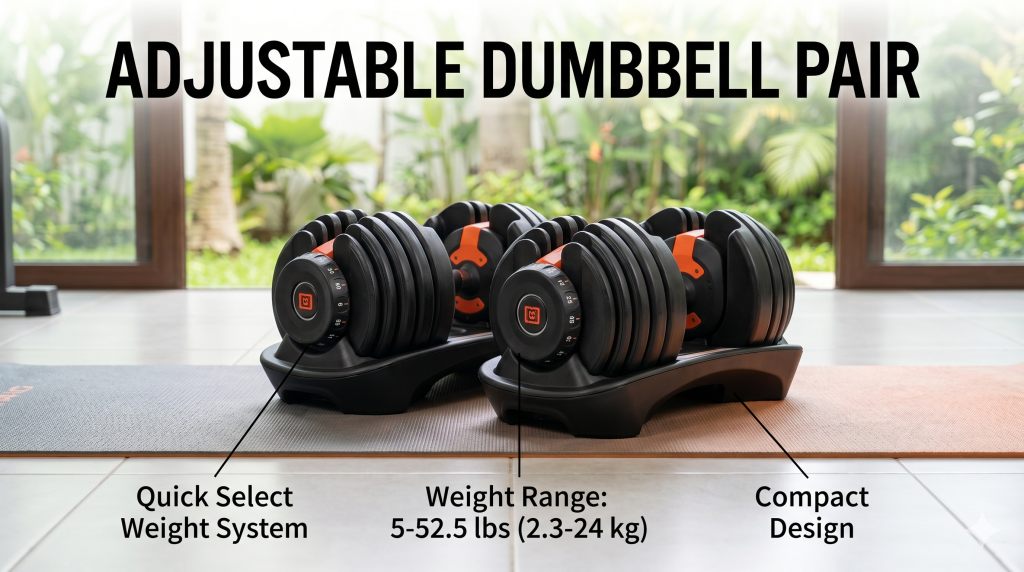
An adjustable dumbbell pair consists of two dumbbells that allow users to change resistance levels by adding or removing weight plates or by using a built-in adjustment system.
Common adjustment styles include:
- Dial-adjust systems
- Selector pin systems
- Twist-lock systems
- Traditional plate-and-lock designs
Most modern adjustable dumbbells can shift between light and heavy weights in seconds, often replacing 10–15 separate dumbbell pairs in one compact setup.
This makes an adjustable dumbbell pair one of the most space-efficient strength-training tools available today.
Why Adjustable Dumbbells Became So Popular
The rise of home fitness dramatically increased demand for compact equipment, and the adjustable dumbbell pair quickly became one of the most practical solutions.
Main reasons for popularity include:
- Saves space compared to full dumbbell racks
- Lower overall cost
- Easy progression between exercises
- Suitable for beginners and intermediate lifters
- Supports full-body workouts
Many users describe an adjustable dumbbell pair as a “complete home gym in two handles” because of how much equipment it replaces.
Design and Build Quality of an Adjustable Dumbbell Pair
Most adjustable dumbbells are engineered around compactness, convenience, and versatility.
Common construction materials include:
- Steel weight plates
- Reinforced plastic housings
- Metal locking systems
- Rubberized or knurled handles
High-quality models usually provide:
- Secure grip during sweaty workouts
- Stable weight balance
- Smooth adjustment systems
- Tight locking mechanisms
Cheaper models, however, may feel less stable or slightly loose under heavier loads.
A premium adjustable dumbbell pair often feels surprisingly solid during daily training.
Real-World Performance of an Adjustable Dumbbell Pair
In practical workouts, an adjustable dumbbell pair performs very well for most users.
Strength Training Exercises
These dumbbells support exercises such as:
- Bicep curls
- Shoulder presses
- Chest presses
- Bent-over rows
- Lunges
- Goblet squats
For beginner and intermediate users, an adjustable dumbbell pair can effectively cover nearly all major muscle groups.
Progressive Overload
One of the biggest advantages is easy weight progression.
Benefits include:
- Small incremental increases
- No need to purchase extra dumbbells
- Fast transitions between sets
This makes progression much more convenient for home workouts.
Circuit Training and HIIT
Fast adjustment systems are especially useful for:
- HIIT routines
- Supersets
- Full-body circuits
- Hybrid strength/cardio training
Modern dial systems allow users to switch weights in just seconds.
Stability During Workouts
Most high-quality adjustable dumbbells feel stable during movement, although some slight rattling may occur depending on the mechanism.
Product testing reviews generally show that a good adjustable dumbbell performs reliably for normal home training.
Space-Saving Benefits: The Biggest Advantage
The biggest reason people buy an adjustable dumbbell air is space efficiency.
Instead of storing:
- Multiple dumbbell pairs
- Large racks
- Bulky gym equipment
You only need:
- One adjustable dumbbell pair
- A small storage corner or stand
This makes them ideal for:
- Apartments
- Dorm rooms
- Small home gyms
- Home offices
- Garage gyms
For limited spaces, an adjustable dumbbell is one of the smartest fitness investments available.
Weight Range and Training Flexibility
Most adjustable systems offer a wide range of resistance.
Typical weight ranges include:
- 5–10 lbs for warmups
- 15–40 lbs for general training
- 40–90 lbs for strength-focused workouts
This flexibility allows users to train different muscle groups without requiring separate equipment.
However, very advanced lifters may eventually exceed the maximum weight limits.
How Fast Can You Adjust an Adjustable Dumbbell Pair?
Adjustment speed is one of the most important usability factors.
Fast Adjustment Systems
Dial and Twist Systems
- Weight changes in seconds
- Excellent for circuit training
- Beginner-friendly
These systems are among the most popular for modern home gyms.
Traditional Plate Systems
Manual Plate Loading
- Slower adjustments
- Requires locking plates manually
- Often more durable
Traditional systems may take more time but sometimes feel more rugged long-term.
Durability of an Adjustable Dumbbell Pair
Durability depends heavily on quality and design.
Strong Areas
- Steel plates last many years
- Handles are generally durable
- Good systems resist daily wear
Weak Areas
- Plastic trays may wear out
- Locking systems may loosen over time
- Dropping weights can damage mechanisms
One important rule:
An adjustable dumbbell is not designed to be dropped like commercial gym dumbbells.
They function more like precision fitness tools.
Safety and Stability
Safety is extremely important when lifting heavier weights.
A quality adjustable dumbbell should provide:
- Secure locking mechanisms
- Stable plate positioning
- Balanced weight distribution
- Anti-slip grips
Potential problems in cheap models include:
- Loose plates
- Difficult adjustments
- Slight imbalance
Most modern systems are safe when used correctly, but users should always verify locks before lifting.
Advantages of an Adjustable Dumbbell Pair
1. Excellent Space Efficiency
Replaces an entire dumbbell rack.
2. Cost Savings
Much cheaper than buying many separate dumbbells.
3. Workout Versatility
Supports full-body strength training.
4. Convenient Progression
Easy resistance changes encourage consistent progression.
5. Home Gym Friendly
Perfect for compact workout environments.
Limitations of an Adjustable Dumbbell Pair
Even though adjustable dumbbells are highly practical, there are still limitations.
Not Ideal for Dropping
Heavy drops may damage mechanisms.
Weight Limits
Advanced strength athletes may outgrow them.
Slightly Bulkier Feel
Longer handles can feel different from gym dumbbells.
Mechanical Wear Over Time
Moving parts eventually experience wear.
Adjustment Time Varies
Some systems are faster than others.
Who Should Use an Adjustable Dumbbell Pair?
An adjustable dumbbell is ideal for:
- Beginners
- Home gym users
- Apartment workouts
- Intermediate lifters
- HIIT and circuit training users
It may be less ideal for:
- Professional bodybuilders
- Competitive powerlifters
- Heavy drop-training workouts
Is an Adjustable Dumbbell Pair Worth Buying?
Yes—an adjustable dumbbell is absolutely worth it for most home fitness users.
Benefits include:
- Massive space savings
- Lower equipment costs
- Full-body workout capability
- Convenient progression
- Strong versatility
While it may not fully replace a commercial gym, an adjustable dumbbell is one of the most efficient and practical home workout tools available today.
Final Verdict on Adjustable Dumbbell Pairs
An adjustable dumbbell truly is a modern home gym hero, combining flexibility, compactness, and workout efficiency into one system.
In Summary
- Replaces multiple dumbbells
- Saves large amounts of space
- Supports many exercises
- Beginner-friendly and versatile
- Requires careful handling for long-term durability
Final conclusion:
A high-quality adjustable dumbbell is one of the best investments for building strength at home without clutter, making it a powerful and efficient solution for modern fitness training.
External Resources
