
Post
Laptop Backpack with USB Port: 9 Reasons It’s Perfect for Modern Commuting
May
Laptop Backpack with USB Port: The Smart Upgrade for Modern Commuting
Why the Laptop Backpack with USB Port Has Become So Popular
In today’s highly connected world, carrying digital devices has become part of everyday life. Laptops, smartphones, tablets, power banks, wireless earbuds, and other gadgets are no longer optional—they are essential tools for work, study, communication, and entertainment. Because of this, choosing the right backpack is no longer just about storage. It is about convenience, organization, protection, and functionality.
Among modern backpack innovations, the laptop backpack with USB port stands out as one of the most practical upgrades for commuters and travelers. It combines traditional backpack utility with a simple but powerful feature: the ability to charge devices on the go.
At first glance, it may seem like a small detail. However, for people who rely heavily on their devices throughout the day, this feature can completely change the commuting experience.
This review takes a deeper look at what makes a laptop backpack with USB port so useful, how it works, its advantages and limitations, and whether it is truly worth buying for everyday use.
What Is a Laptop Backpack with USB Port?
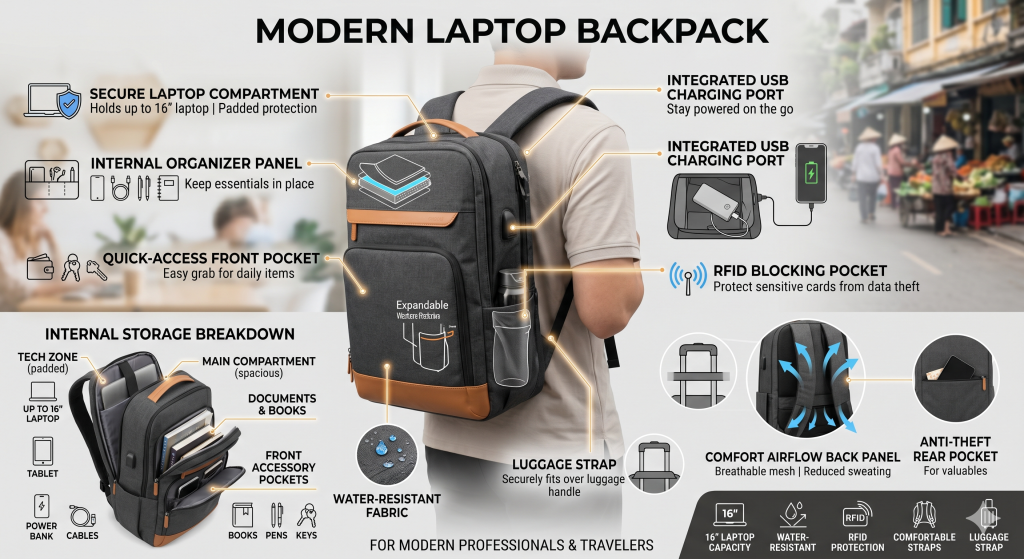
A laptop backpack with USB port is a specially designed backpack that includes an external USB charging interface connected to an internal cable system.
Inside the backpack, there is usually a dedicated pocket where users place a power bank. This power bank connects to an internal USB cable that runs to an external port on the backpack’s exterior—typically located on the side or shoulder strap.
This setup allows users to plug in their charging cable from the outside and charge devices such as smartphones, tablets, or wireless accessories while walking or commuting.
It is important to understand that the backpack itself does not generate electricity. Instead, it acts as a convenient extension system between the power bank and the device.
This simple design is what makes the laptop backpack with USB port so practical in real-world use.
Smart Internal Organization System
One of the biggest strengths of a laptop backpack with USB port is its internal structure.
Most quality models include:
- A padded laptop compartment (14–17 inches)
- A dedicated power bank pocket
- Internal cable routing system
- External USB charging interface
- Multiple accessory compartments
This layout ensures that devices, cables, chargers, and accessories remain organized and protected.
One major advantage of this design is cable management. Instead of carrying loose charging cables or exposing the power bank, everything remains neatly stored inside the backpack.
This reduces clutter and improves usability, especially during busy travel or commuting situations.
How the USB Charging Feature Works
Understanding the mechanism helps buyers set realistic expectations.
The charging system works in four simple steps:
- A power bank is placed inside the backpack
- The power bank connects to the internal USB cable
- The cable connects to the external USB port
- The user plugs their device into the outside port
This allows continuous charging while moving.
However, users should remember:
- The backpack does not generate electricity by itself
- A separate power bank is required
- Charging speed depends on the quality of the power bank
- Most backpacks do not include a power bank in the package
Although simple, this system adds significant everyday convenience.
Everyday Convenience for Commuters and Travelers
The biggest advantage of a laptop backpack with USB port is practical convenience.
Easier Daily Commuting
Modern commuters often rely on smartphones for GPS navigation, messaging, music streaming, or work communication. A low battery can quickly become frustrating during travel.
With a laptop backpack with USB port, devices can continue charging while walking, cycling, or riding public transportation.
Better Travel Flexibility
Airports, buses, and train stations do not always provide accessible charging outlets. USB backpacks eliminate the need to stop and search for wall chargers.
More Freedom for Students and Professionals
Students and remote workers frequently move between classrooms, libraries, offices, and cafés. Portable charging support allows continuous productivity throughout the day.
Useful for Outdoor Activities
For walking, sightseeing, hiking, or cycling, users can keep devices powered without interrupting movement.
This convenience is one of the main reasons the laptop backpack with USB port has become increasingly popular worldwide.
Comfortable and Ergonomic Design
Because backpacks are worn for long periods, comfort matters just as much as functionality.
Most well-designed laptop backpacks with USB port include:
- Padded shoulder straps
- Breathable back panels
- Lightweight but durable construction
- Balanced weight distribution
These features help reduce shoulder and back strain during long commutes or travel days.
Ergonomic support becomes especially important when carrying laptops, books, chargers, water bottles, and personal items.
A poorly designed backpack may cause discomfort over time, while a quality laptop backpack with USB port improves posture and reduces fatigue.
Security Features for Modern Lifestyles
Security has become another major advantage of modern laptop backpacks with USB port.
Common protective features include:
- Hidden zipper pockets
- Anti-theft rear compartments
- RFID-blocking pockets in premium models
- Cut-resistant materials
- Padded laptop sleeves
These features help protect valuable electronics and personal belongings in crowded areas such as airports, buses, train stations, and city streets.
As digital devices become more expensive and important, backpack security becomes increasingly valuable for everyday users.
Durability and Material Quality
Quality varies depending on brand and price, but most laptop backpacks with USB port use durable materials such as:
- Water-resistant polyester
- Oxford fabric
- Nylon blends
- Reinforced stitching
Water resistance is particularly important because it helps protect electronic devices from rain or accidental spills.
Higher-quality backpacks also include:
- Strong zippers
- Reinforced carrying handles
- Shock-resistant laptop padding
- Durable internal lining materials
These details improve long-term reliability and device protection.
A quality laptop backpack with USB port can easily last for years with proper care.
Common Limitations to Consider
Despite the advantages, there are still some limitations users should understand.
Requires a Separate Power Bank
The backpack itself is not a battery. Users must buy and carry a power bank separately.
Charging Performance Depends on the Power Bank
Fast charging capability depends entirely on the external battery and cable quality.
Low-Quality Models May Wear Out Quickly
Cheaper backpacks sometimes use weak internal cables or poorly protected USB ports that may fail over time.
Not Always Fully Waterproof
While many models are water-resistant, very few are completely waterproof during heavy rain.
Understanding these limitations helps buyers make smarter purchasing decisions and avoid unrealistic expectations.
Who Should Buy a Laptop Backpack with USB Port?
A laptop backpack with USB port is especially useful for:
- Students
- Office workers
- Travelers
- Remote workers
- Digital nomads
- Content creators
- Tech enthusiasts
- Frequent commuters
Anyone who relies heavily on smartphones, laptops, or portable electronics can benefit from the added charging convenience and organization.
Final Verdict on Laptop Backpack with USB Port
A laptop backpack with USB port is one of the smartest modern accessories for people who depend on digital devices throughout the day.
While the technology itself is simple, the real-world benefits are extremely practical:
- Convenient charging while moving
- Better organization for cables and gadgets
- Improved commuting and travel experience
- Comfortable ergonomic design
- Added security for electronics and belongings
It does require a separate power bank and is not a built-in charging system, but the convenience it adds to everyday life is undeniable.
For students, professionals, commuters, and travelers, a laptop backpack with USB port is absolutely worth considering. It transforms an ordinary backpack into a practical everyday tool designed for modern connected lifestyles.
